LoloBuy Total Landed Cost: Build a Worksheet Before Shipping
A LoloBuy total landed cost worksheet should answer one practical question: what will the order have cost when the parcel reaches you, not merely when the products are paid for? Separate the cost into six layers, record estimates as estimates, replace them with live account totals as each stage closes, and allocate shared parcel costs only after packed weight and dimensions are available.
Verified platform context: LoloBuy's public website currently describes ordering from a pasted Chinese product link, warehouse quality inspection and photographs, 90 days of free storage, and consolidation of stored items into an international parcel. This guide uses those stages as worksheet checkpoints. It does not publish a fixed fee, exchange rate, route, delivery time, tax result or refund outcome.
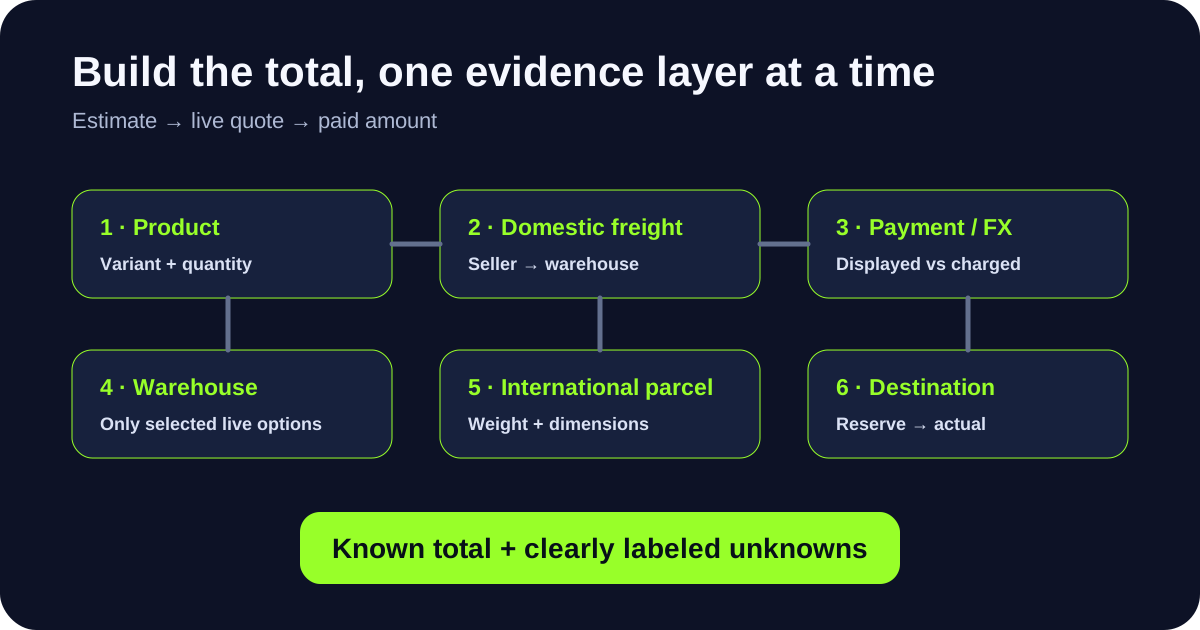
What “total landed cost” should mean in your worksheet
Total landed cost is the sum of costs needed to move selected products from the seller stage through the warehouse and international parcel stage to the destination, plus any destination charges that actually apply. It is a planning total, not one universal number displayed at the moment you save a product link.
The distinction matters because different numbers become known at different times. A listing can show an item price before domestic seller-to-warehouse freight is final. A warehouse record can show an item after arrival but before it is packed with others. An international estimate can change when packed dimensions, route eligibility and current checkout terms are known. Destination taxes or carrier charges depend on the shipment and applicable rules.
Your worksheet therefore needs three states for every cell: estimate, live quoted and paid. Add the date and source beside each value. Never silently overwrite the estimate; retaining both numbers shows where the budget changed and makes the next order easier to plan.
Record six cost layers instead of one checkout total
1. Product cost
Use one row per exact product variant. Record the live product amount shown when the order is created, quantity, color, size or version, and the original product link. If the seller price changes before payment, update the paid column while preserving the earlier estimate. Do not treat a spreadsheet price or an old screenshot as a current quote.
2. Seller-to-warehouse freight
Domestic freight is the movement from the seller to the purchasing warehouse. Keep it separate from international shipping. When several items come from one seller, note whether the live order shows one combined domestic charge or item-level charges. Do not divide a shared charge equally unless that is the allocation rule you deliberately choose.
3. Payment and currency difference
Record the amount displayed before payment, the amount ultimately charged in your account currency, and any payment cost that is visibly itemized. The difference may reflect conversion, provider treatment or timing; the worksheet should document what occurred without inventing a platform markup. Check the live payment screen before authorizing the transaction.
4. Warehouse-stage choices
Warehouse QC evidence determines whether an item belongs in the parcel, but a photo is not itself permission to assume a cost. Record only optional services, packing choices or other amounts that are actually displayed for the order. LoloBuy publicly states that it provides warehouse inspection and photographs and 90 days of free storage. That does not prove every possible warehouse request is free or that every seller problem has the same remedy.
5. International parcel cost
This layer begins as a range, then becomes a live parcel quote, and finally a paid amount. Preserve actual packed weight, parcel dimensions, route name as displayed, packaging decisions and the quote date. Weight alone is not enough because billable weight can depend on dimensions and current route rules. Use the shipping cost preparation guide before accepting the final quote.
6. Destination charges and delivery costs
Create a destination reserve rather than claiming a guaranteed tax-free or duty-free result. Research the current destination rules and carrier process for the shipment. Replace the reserve only when an actual tax, duty, handling or local-delivery charge appears. Legal thresholds and collection methods can change, so a previous parcel is evidence of that parcel—not a promise for the next one.
Build the worksheet with evidence beside every number
| Layer | Estimate | Live or paid | Evidence to save |
|---|---|---|---|
| Product | Listing amount | Order payment | Link, variant, quantity, order record |
| Domestic freight | Seller-stage estimate | Order amount | Seller and shipment grouping |
| Payment / FX | Budget buffer | Displayed and charged totals | Dated payment summary |
| Warehouse | Only known choices | Itemized live amount | QC decision and selected option |
| International parcel | Planning range | Final live quote | Packed weight, dimensions, route |
| Destination | Researched reserve | Actual charge | Applicable notice or receipt |
Put an “unknown” marker in a cell that cannot yet be supported. Zero means you confirmed that the charge is zero; blank means the cost has not been checked. That small distinction prevents an incomplete total from looking final.
Add a confidence column. Product payments and completed domestic freight can be high-confidence. An unpacked parcel estimate should remain low-confidence. A destination reserve is a planning allowance until an applicable charge is known. The grand total should display both a current known total and a remaining range.
Calculation example: keep the arithmetic useful and the assumptions visible
Suppose a planning sheet contains three accepted items. To avoid suggesting current platform prices, the example uses fictional worksheet units, not a currency or LoloBuy fee schedule.
Illustrative calculation only: products 180 + 120 + 80 = 380 units; seller-to-warehouse freight 12 + 8 + 10 = 30; observed payment difference 9; an itemized warehouse choice 6; international parcel quote 150; destination reserve 40. The planning total is 380 + 30 + 9 + 6 + 150 + 40 = 615 units. If the destination reserve is not charged, the completed total becomes 575 units. If it is charged differently, replace the reserve with the actual amount.
The calculation is deliberately simple. Its value is the audit trail: every paid layer can be reconciled, while the one unresolved reserve remains visibly provisional. A worksheet that reports 615 as a guaranteed total would be misleading.
Allocate shared parcel costs without creating false precision
If you want a landed cost per item, shared parcel costs need an allocation rule. Equal division is easy but often distorts reality: a bulky jacket and a small accessory did not contribute equally to parcel size. Weight allocation is more defensible when item weights are available. Calculate each item's share as its weight divided by the combined item weight, then multiply that share by the shared international cost.
For example, if three items represent 50%, 30% and 20% of combined item weight, a 150-unit parcel charge can be allocated as 75, 45 and 30 units. Mark the method as editorial allocation; it is not necessarily how the carrier prices the parcel. When a rigid box or oversized shape drives dimensions, consider assigning a specific packaging or volume adjustment to that item instead.
Allocation supports decisions such as whether a low-priced accessory remains sensible inside a parcel. It should not be used to claim an exact standalone shipping price the item never received.
Use decision rules before adding, consolidating or shipping
- Before paying: reject any row without an exact variant, current product amount and domestic-freight check.
- At warehouse arrival: keep failed or unresolved QC items outside the parcel budget until the live order action is decided.
- Before consolidation: compare compatible groups; one route-sensitive or bulky item may change the options for everything else.
- At parcel quote: replace estimated shipping with packed weight, dimensions and the current route total.
- Before dispatch: recheck recipient details, destination requirements and what the live checkout includes.
- After delivery: reconcile actual destination charges and note why estimate and final total differed.
Free warehouse time can help items arrive at different dates before consolidation, but waiting is not automatically cheaper. Use the warehouse storage planning guide to set a personal decision date. A delayed low-value item should not hold an accepted parcel indefinitely merely because storage remains available.
Keep cost and condition decisions connected. If QC photos reveal a meaningful mismatch, preserve the product link, selected variant, order record and relevant images before choosing the action shown for that order. The QC photo guide explains that evidence review. This worksheet does not promise a return, exchange or refund.
Final landed-cost check before parcel submission
- Every selected item passed its recorded QC decision.
- Product and domestic-freight payments match the order records.
- Payment differences are observed values, not guessed percentages.
- Only visible, selected warehouse choices are included.
- Packed weight, dimensions and live international quote replace estimates.
- The destination reserve is labeled provisional until an actual charge exists.
- Shared costs use a stated, consistent allocation rule.
- The total shows its calculation date and remaining unknowns.
A useful LoloBuy cost worksheet is conservative: it exposes unknowns rather than hiding them inside one attractive number. That makes the sheet valuable before payment, at warehouse arrival, during consolidation and after delivery. The final total becomes a record you can learn from, while the next order still begins with fresh live evidence.
Evidence ledger and editorial limits
Official source checked 12 August 2026: LoloBuy public website. It was used only for current platform statements about starting an order with a pasted Chinese product link, warehouse inspection and photographs, 90 days of free storage, and consolidation into an international parcel. Platform statements are not independent proof of every seller, route, destination or outcome.
The six-layer worksheet, confidence states, example units, allocation methods and decision rules are independent LoloBuyChina editorial analysis. No fixed fee, exchange rate, shipping price, photo count, return window, tax treatment, route, delivery time or refund outcome is asserted.