LoloBuy Warehouse Storage Planning: How to Use the 90-Day Window
The useful way to think about LoloBuy warehouse storage is as a scheduling tool. Record each item's arrival date, finish its QC decision promptly, group only compatible accepted items, and choose a personal parcel deadline well before the published storage limit. Storage can help stagger seller arrivals, but it is not a universal return period or a reason to postpone a mismatch.
Verified platform statement: LoloBuy's public website currently describes warehouse quality inspection and photographs, 90 days of free storage, and the option to consolidate stored items into an international parcel. It does not establish that every seller return window lasts 90 days, so this guide treats those decisions separately.
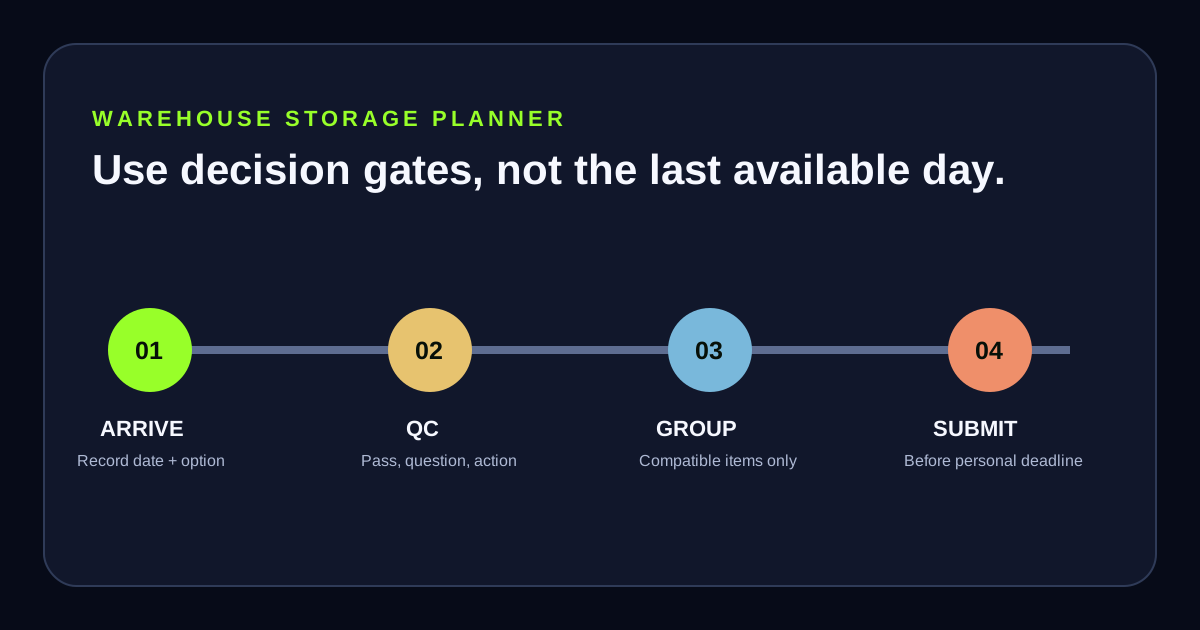
What the 90-day LoloBuy warehouse statement does—and does not—mean
LoloBuy publicly says that items receive 90 days of free warehouse storage after they reach the warehouse. That statement supports a practical benefit: products bought from different sellers do not have to arrive on the same day before they can be considered for one parcel. A slower seller can arrive after a faster one while the earlier accepted item remains stored.
The statement should not be stretched into promises that are not published. It does not mean every seller will accept a return for 90 days, that every problem can wait, that storage remains free after the published period, or that a parcel submitted near the end will be packed and dispatched instantly. Seller action, warehouse storage and international parcel processing are separate stages.
Use the 90 days as an outer planning boundary, not as your working deadline. Your personal deadline should include room for unresolved QC, another seller arrival, a packing question and the final parcel decision. The correct date for a live order remains the date and status shown in the current account record.
Build an arrival ledger before the first package reaches the warehouse
A storage plan begins with one row per item, not one row per payment. Record the original product link, seller, exact variant, purchase date and expected domestic stage. When the item is marked received, add the warehouse arrival date shown in the order record. Keep the seller listing and selected option beside that date so later photos are compared with evidence instead of memory.
Add five decision fields: QC status, problem or question, action deadline shown in the current order, parcel group and personal ship-by date. Avoid writing only “good” or “bad.” A useful status is “identity matched; strap missing from available photos; targeted question open.” That wording explains what is complete and what still blocks acceptance.
- Source URL and exact color, size, version or bundle
- Warehouse arrival date from the current order record
- QC state: pending, pass, focused question or action
- Any live order deadline or seller condition displayed
- Provisional parcel group and an earlier personal deadline
Keep this ledger private. It does not need passwords, payment details, a full address or tracking number. Its purpose is continuity across items and sellers, not a public order archive.
Finish QC decisions early instead of spending the storage window
LoloBuy's public workflow includes quality inspection and photographs when goods reach the warehouse. Review those images when the item arrives: confirm identity, selected variant, quantity, visible included pieces and meaningful condition. If one measurement or angle would change the decision, ask a focused question through whatever option is currently available rather than waiting for the rest of the haul.
A later parcel deadline cannot repair a missed seller action window. If a clear wrong color, size, model or damaged component appears, preserve the source listing, selected option, order record and relevant photo. Then check the live action available for that particular order. This article does not promise a return, exchange, refund, response time or fee because those depend on current terms, seller conditions, product and timing.
Accepted items can wait for a compatible group. Unresolved items should remain outside parcel selection. Marking those states separately prevents a buyer from submitting an entire group merely because most products look ready.
Group stored items by compatibility, not just arrival order
After QC, place each accepted item into a provisional group. Consider shape, fragility, packaging, product type and whether the item may affect available routes. Soft clothing and a rigid boxed item may need different protection. A battery, liquid, magnet or other route-sensitive category may need research before it joins ordinary goods. The live parcel interface and destination rules control eligibility.
LoloBuy publicly describes consolidating warehouse items, but consolidation is not proof that one parcel will always be cheaper or safer. A larger box may change billable volume, and one sensitive item can narrow the route list. Keep groups provisional until packed weight, dimensions and current route options are known.
A simple three-column decision works: ready and compatible; ready but route-sensitive; unresolved. The first column can form the main parcel candidate. Compare the second both inside and outside the group when live options are available. Never move the third into submission until its evidence question is closed.
Use a staged timeline with safety margins
Imagine item A arrives on day 1, item B on day 12 and item C on day 26. Item A passes QC immediately. Item B needs one size-label clarification and passes on day 14. Item C is a route-sensitive accessory. The correct question on day 26 is not “how many free days remain?” It is whether A and B should form a compatible parcel while C is checked separately.
Illustrative schedule, not a platform promise: days 1–3 review A; days 12–14 close B; day 26 research C; day 35 compare parcel groups; day 40 submit the chosen parcel. The numbers demonstrate a planning method only. Seller timing, warehouse processing, packing and route availability are live variables.
Set reminders from each item's own arrival date rather than from the first order payment. Use at least two internal checkpoints: a QC-complete target and a parcel-decision target. Leave a final margin that is meaningful for your circumstances instead of designing a plan that succeeds only if every late step is immediate.
Decide when waiting is useful and when it creates risk
Waiting is useful when a known compatible item is already on its way, the earlier goods have passed QC, and the combined parcel can be compared with split options before a comfortable personal deadline. Waiting is less useful when the later seller has no clear progress, an earlier item has an unresolved mismatch, or the possible addition could change route eligibility.
Use a stop rule. For example: if the later item has not reached the warehouse by the personal decision date, submit the ready group after checking current packing and route data. A stop rule prevents sunk-cost thinking, where one delayed low-value item holds several accepted products close to the storage boundary.
Run a final storage-to-parcel check
- Confirm every selected item has a recorded QC pass.
- Remove any item with an open question or live seller action.
- Review the oldest arrival date and current storage status.
- Check whether product types remain compatible with one route group.
- Choose packaging only after deciding what must be protected or retained.
- Use final packed weight and dimensions, not seller estimates.
- Recheck destination, recipient details and the live route terms.
- Save the parcel record with the item ledger and submission date.
Storage planning ends when the parcel decision becomes better supported by live evidence than continued waiting. The aim is not to use every available day. It is to turn staggered arrivals into orderly QC and consolidation decisions while preserving enough time to handle an unexpected problem.
Evidence ledger and editorial limits
Official source checked 10 August 2026: LoloBuy public website. It was used only for LoloBuy's current statements about ordering from a pasted Chinese product link, warehouse inspection and photographs, 90 days of free storage, and consolidation into an international parcel. These platform statements are not independent proof of every seller, product, destination or outcome.
The arrival ledger, three-group method, staged timeline and stop rule are independent LoloBuyChina editorial analysis. No fixed return rule, photo count, storage extension fee, route, packing duration, shipping price, delivery time or refund outcome is asserted.